Published October 2026·last updated 24 October 2026·registers as extracted 24 October 2026
If you study, fund or sell to UK charities, you start from the same place as everyone else: the public registers kept by the three charity regulators. Each register has a website field, and this paper measures how far you can trust it: how often it's filled in, what's actually in it, how many charities share one website, and whether a recorded address still works. Everything here comes from the registers' own published data plus one measured crawl. No charity's website was contacted to produce this document, and we publish aggregates only - no charity is named or identifiable.
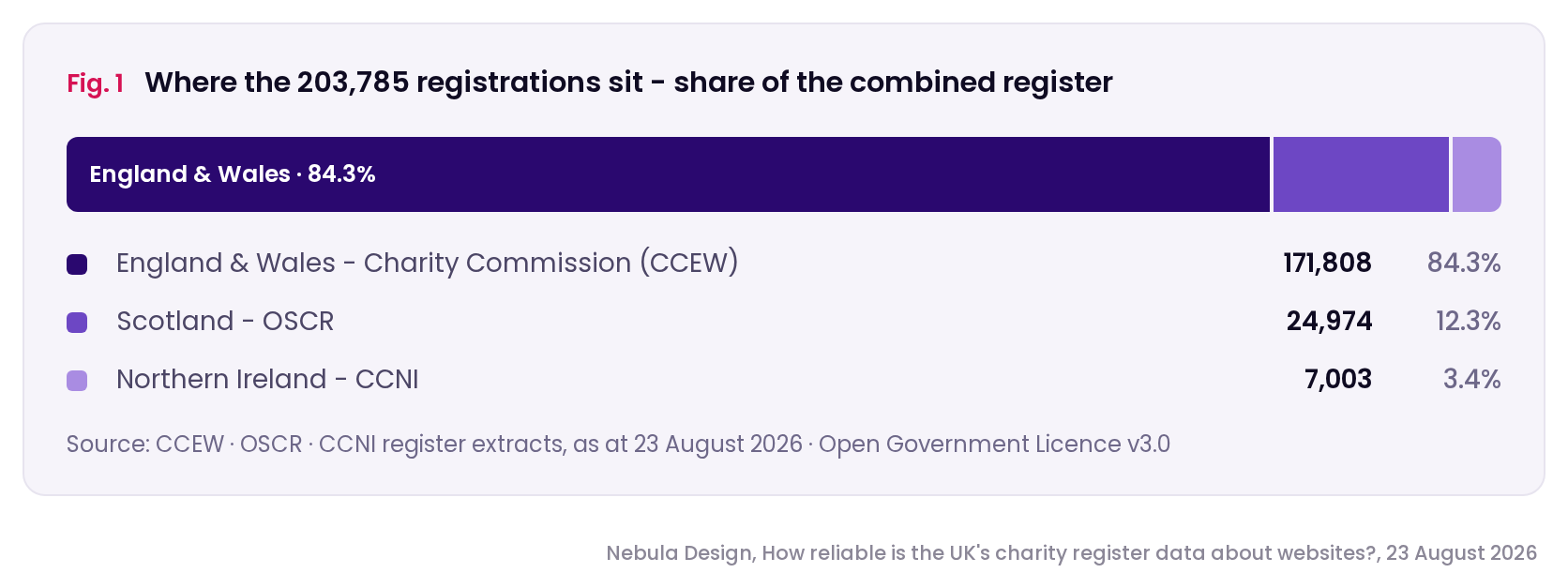
Three regulators - one each for England & Wales, Scotland and Northern Ireland - publish their registers as open data. Together they hold 204,670 registrations. But registrations aren't organisations: at least 1,300 charities appear on two registers at once, so our best estimate is 203,370 distinct organisations. The regulators don't publish which records match which, so some of the double counting can't be removed at all.
The totals also miss some charities entirely: "exempt" and "excepted" organisations (many universities, academy schools, some churches) never appear on the England & Wales register, and Northern Ireland's register is still recovering from a 2019 re-registration exercise, so its coverage isn't directly comparable.
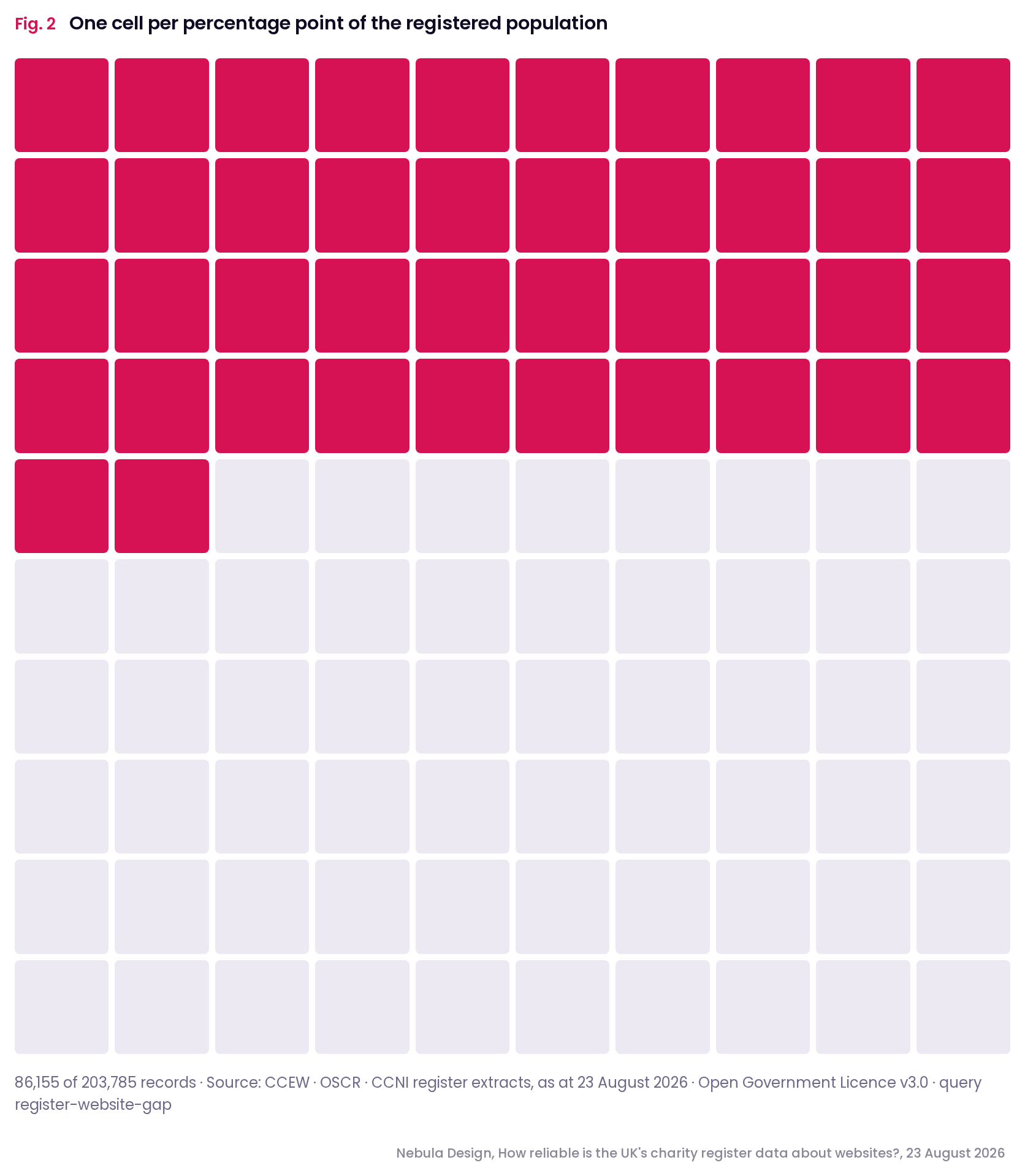
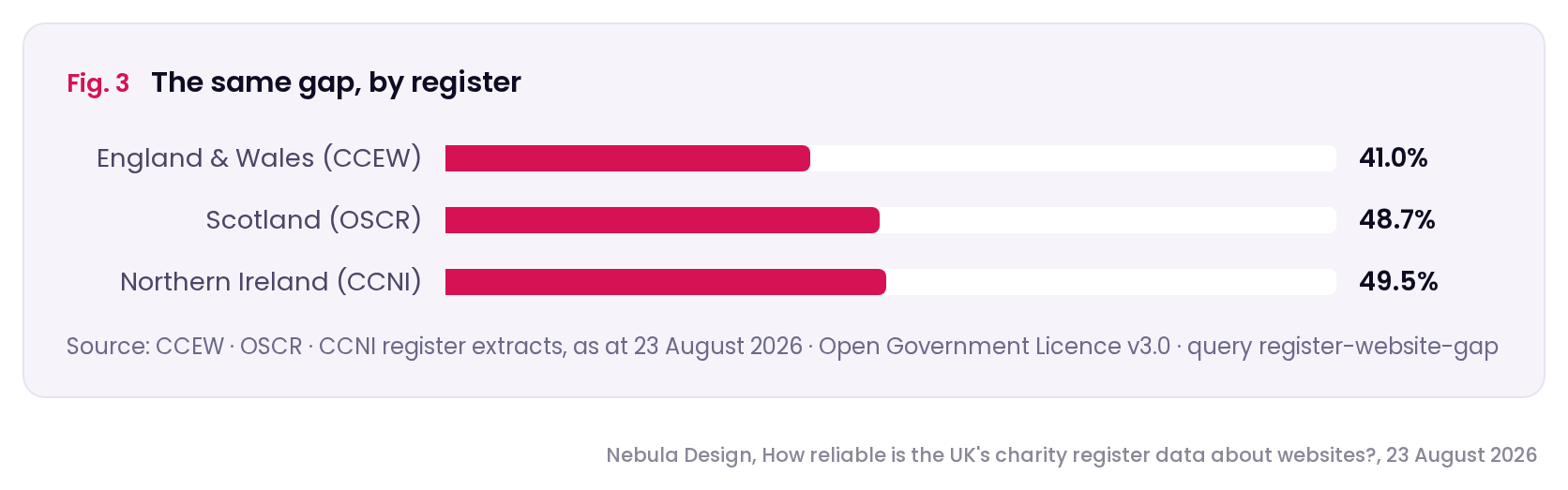
42in every 100 register records hold no usable website
| Register | Organisations | No usable website | Share |
|---|---|---|---|
| England & Wales (CCEW) | 172,693 | 70,803 | 41.0% |
| Scotland (OSCR) | 24,974 | 12,163 | 48.7% |
| Northern Ireland (CCNI) | 7,003 | 3,466 | 49.5% |
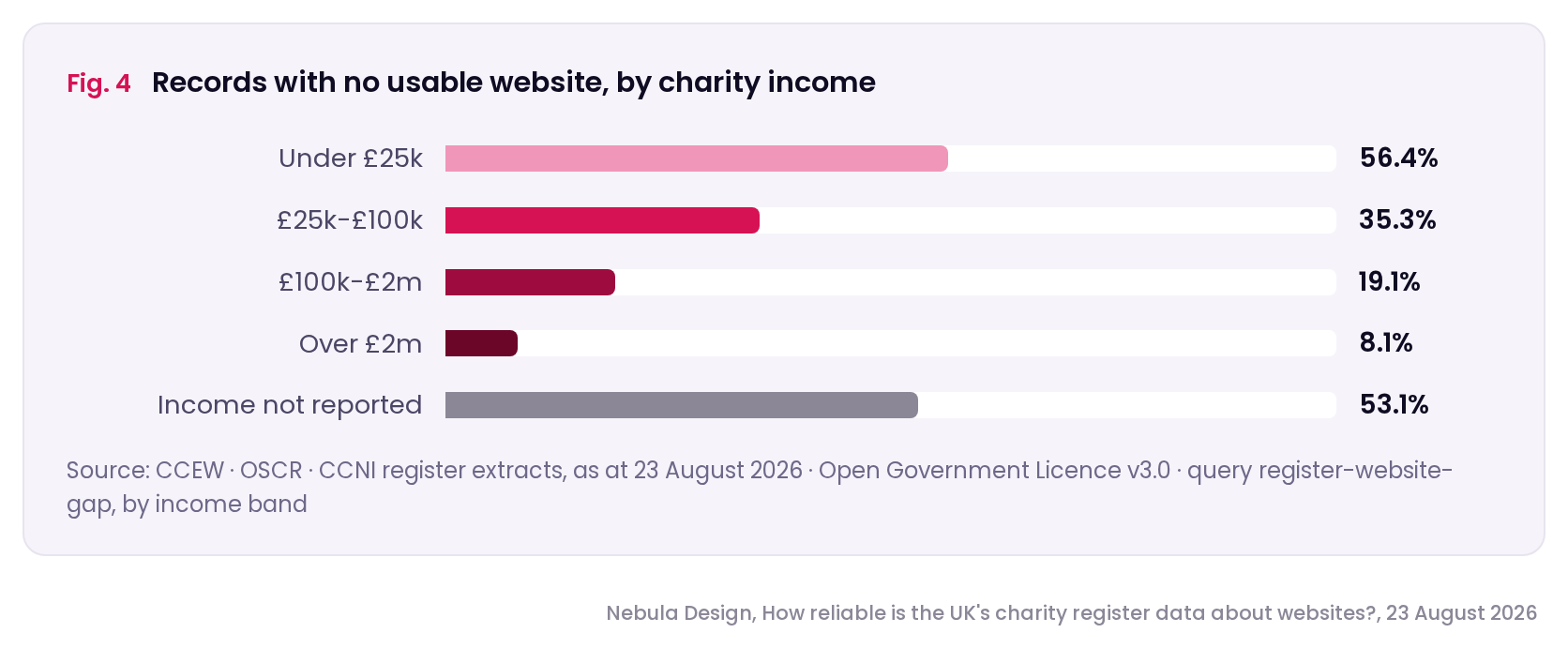
The same gap, cut by annual income
More than half of the smallest charities have no usable website on the register, compared with fewer than one in ten of the largest. Any study built on "charities with websites" will therefore skew towards big organisations, even though small ones make up most of the sector.
| Annual income | Organisations | No usable website | Share |
|---|---|---|---|
| Under £25k | 102,648 | 57,841 | 56.3% |
| £25k-£100k | 39,447 | 13,916 | 35.3% |
| £100k-£2m | 45,121 | 8,653 | 19.2% |
| Over £2m | 7,320 | 603 | 8.2% |
| Income not reported | 10,134 | 5,419 | 53.5% |
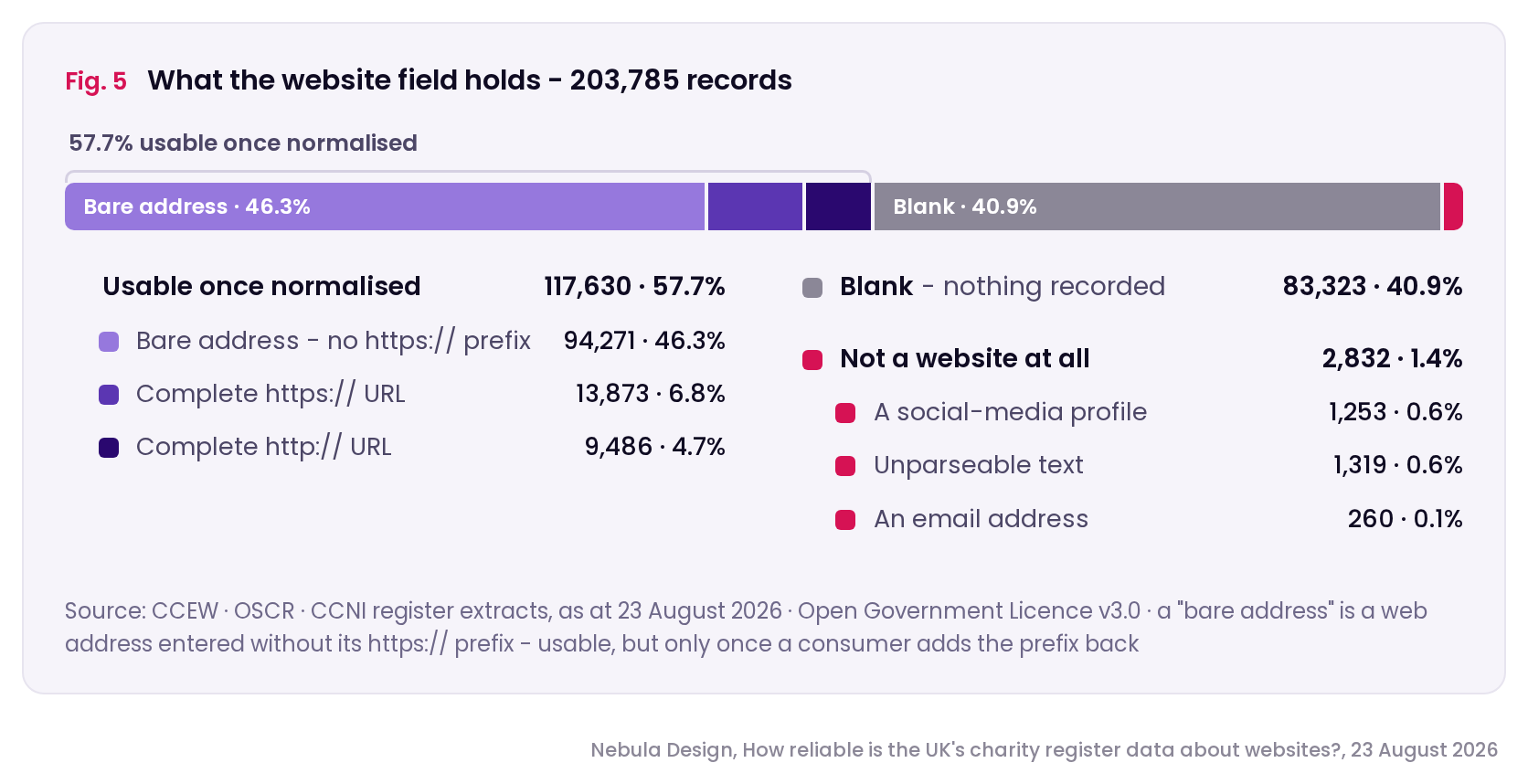
When the field is filled in, the
most common entry isn't a full URL - it's a bare address like
example.org.uk with no https:// in front. That's fine for a
person, but software has to correct it, and every system corrects it slightly
differently. Beyond that come the stranger entries: Facebook pages, email
addresses, and text that isn't a web address at all, all filed as "the
charity's website".
| What the field holds | Records | Share |
|---|---|---|
| A bare address without http(s):// - usable once normalised | 94,559 | 46.2% |
| A well-formed https:// URL | 14,209 | 6.9% |
| A well-formed http:// URL | 9,470 | 4.6% |
| Blank | 83,581 | 40.8% |
| A social-media profile, not a website | 1,265 | 0.6% |
| Unparseable text | 1,320 | 0.6% |
| An email address in the website field | 266 | 0.1% |
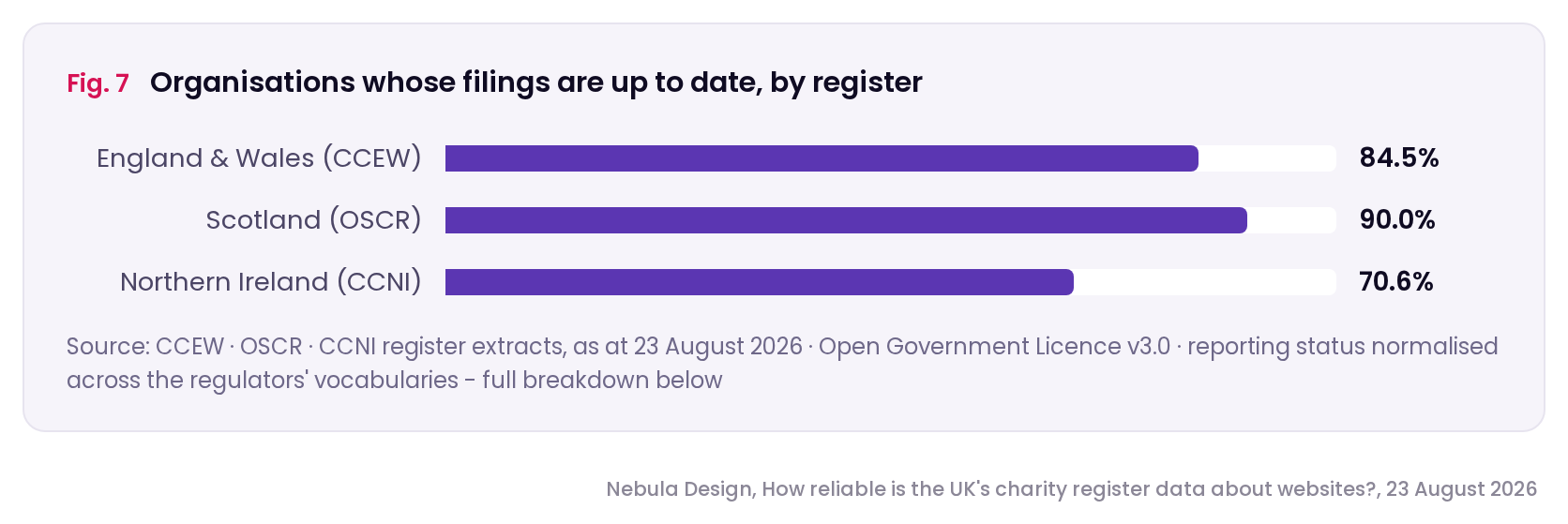
By the regulators' own accounting, most charities file on time. So the registers aren't stale in the way people usually assume - the records themselves are looked after.
| Register | Up to date | Filed late | Overdue | New | Other |
|---|---|---|---|---|---|
| England & Wales (CCEW) | 85.1% | 4.6% | 5.3% | 4.8% | 0.2% |
| Scotland (OSCR) | 90.0% | — | 9.7% | — | 0.3% |
| Northern Ireland (CCNI) | 70.6% | 11.7% | 12.9% | 4.8% | 0.0% |
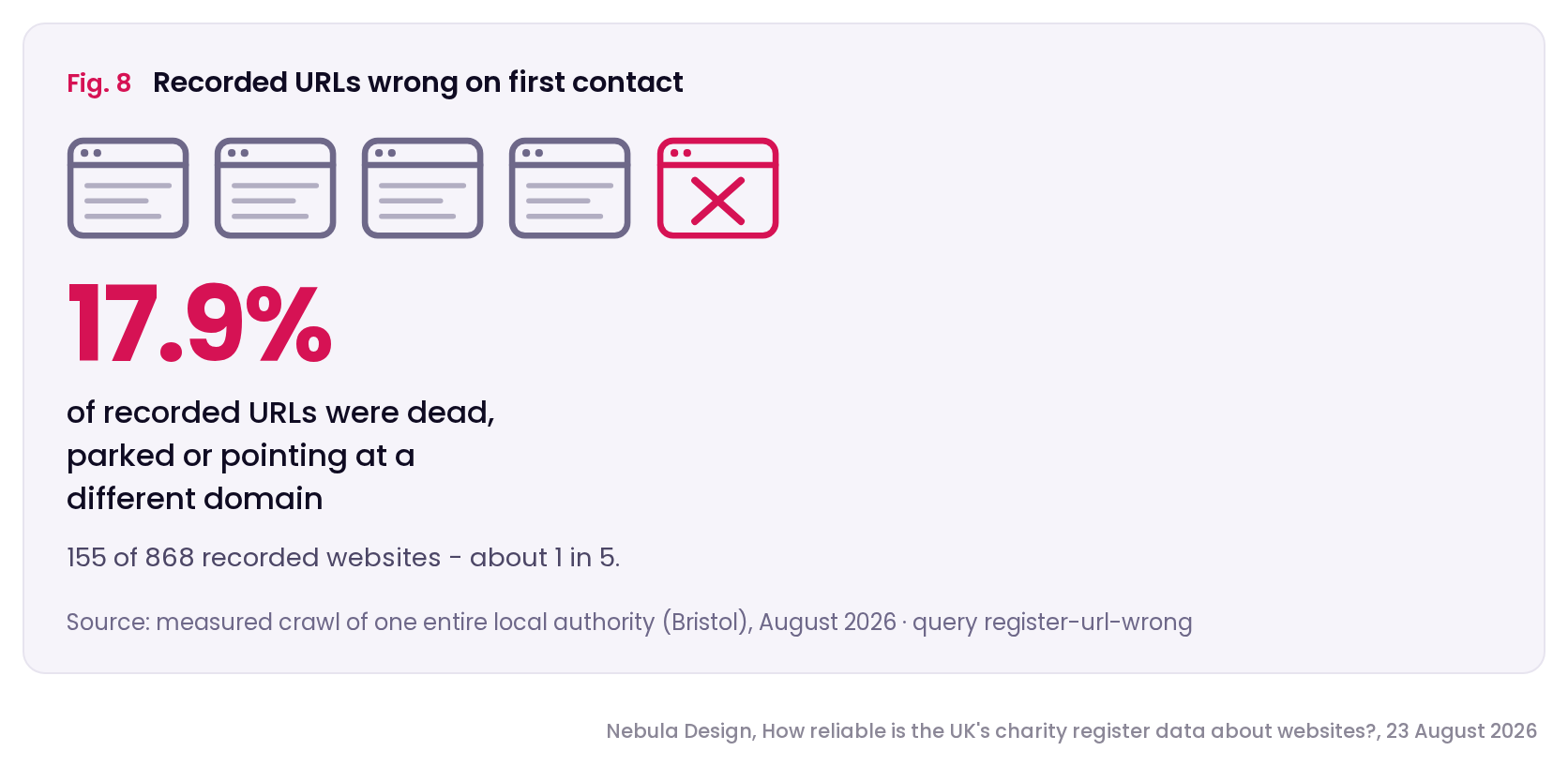
17.9%of recorded URLs were dead, parked or pointing at a different domain
155 of 868 recorded websites - about 1 in 5.
The website field is a different matter. In August 2026 we crawled every recorded charity website in Bristol - 868 of them - and nearly one in five didn't work: the address was dead, parked, or pointing at a different domain. Bristol alone can't give us a national figure; that's what the next stage of this research is for.
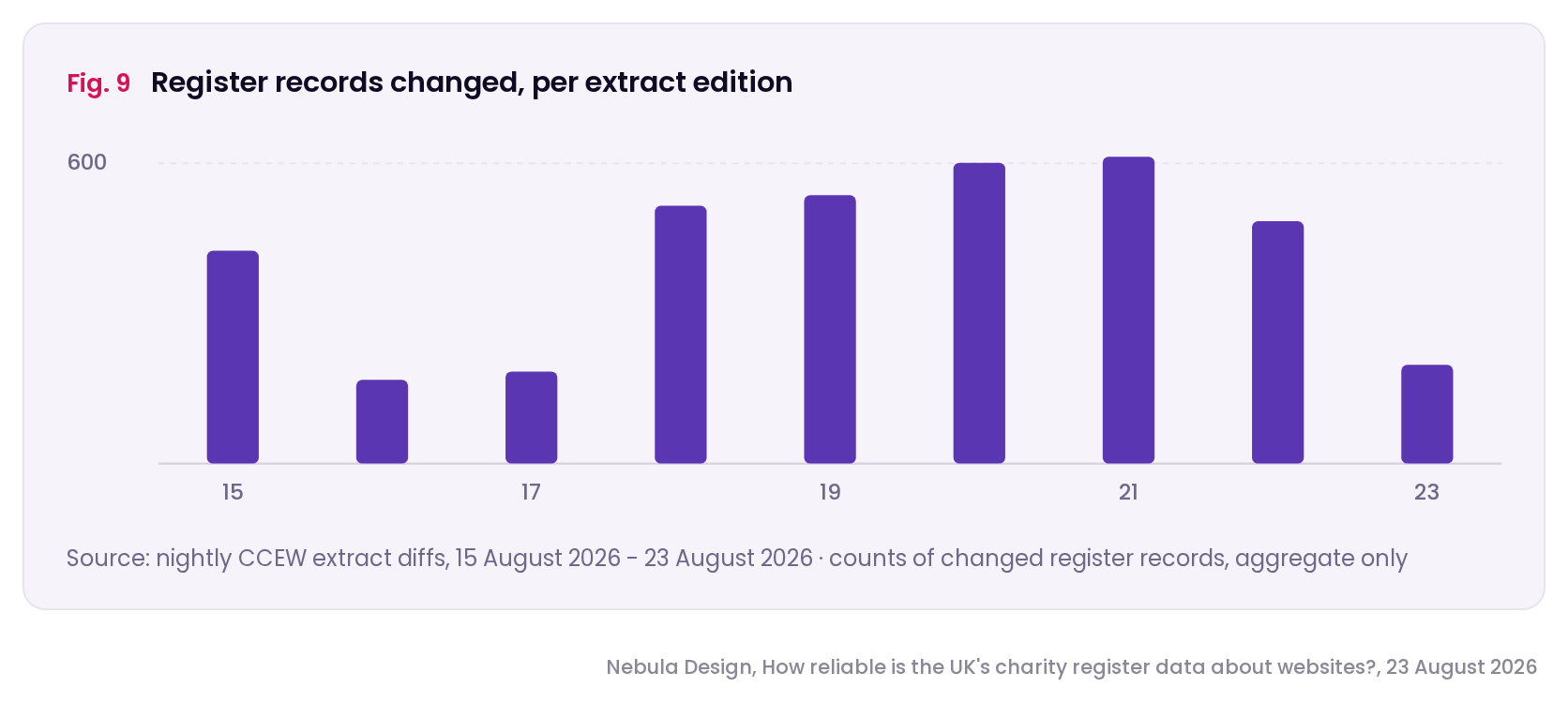
The Charity Commission rebuilds its register extract nightly, and this page keeps up: our pipeline checks the new edition every morning, diffs it against the last, and regenerates every figure above from the current register. Hover a bar for the day's breakdown - charities registered and removed, website addresses, incomes, names, postcodes and reporting statuses changed.
Feel free to copy and share these - please credit Nebula Design and link back to this paper.
42.2% of UK charity register records hold no usable website - 86,432 of 204,670 registrations across the three regulators.
56.3% of the smallest charities (under £25k income) have no usable website on the register, against 8.2% of those over £2m.
17.9% of recorded charity website addresses were wrong on first contact - dead, parked, or pointing at a different domain (868 sites, Bristol).
46.2% of register records hold a bare web address with no https:// in front, so anyone using the data has to clean it up first.
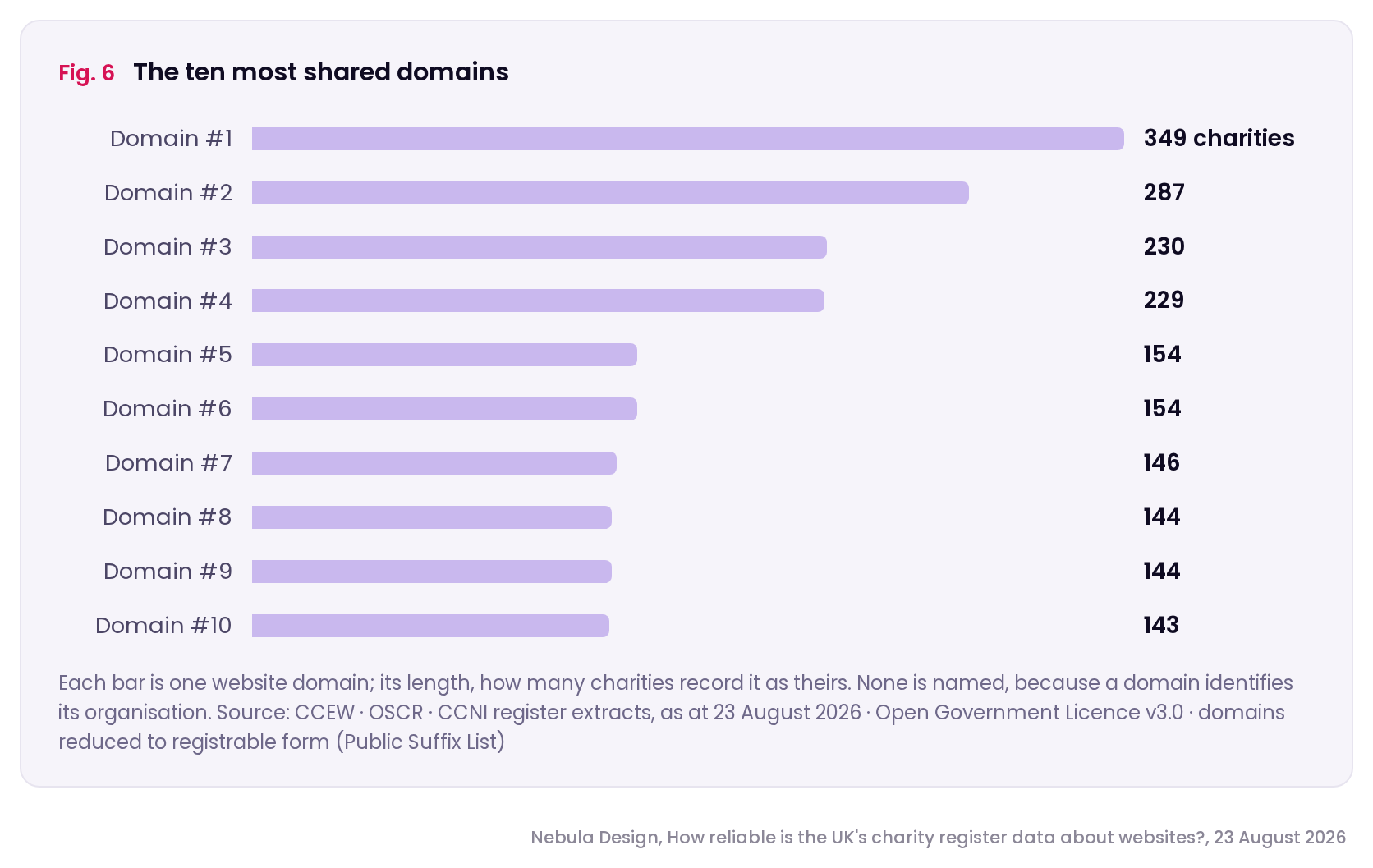
One website domain is recorded as the website of 349 different charity registrations - the largest shared domain on the UK registers.
The three UK charity registers hold 204,670 registrations, but only around 203,370 distinct organisations - some charities are registered twice.
Sources. Charity Commission for England and Wales daily register extract; OSCR Scottish Charity Register download; Charity Commission for Northern Ireland register export - all as at 24 October 2026, all used under the Open Government Licence v3.0 (register data is Crown Copyright). Postcode geography: ONS National Statistics Postcode Lookup (February 2026 edition), OGL v3.0.
Processing. Registered main records only: subsidiary (linked) registrations and removed charities are excluded. Website fields are normalised with a single written rule (scheme added to bare addresses; social profiles, email addresses and unparseable values classed as unusable). Domains are reduced to registrable domains using the Public Suffix List. The §5 crawl read one homepage per recorded website with an identified crawler honouring robots.txt (details: nebula.design/bot), at most a handful of requests per site; no security scanning of any kind; no personal data collected. Sites whose robots.txt disallowed us were never requested and are reported as not assessed: they are excluded from every crawl-derived rate on this page, numerator and denominator alike, because we hold no observation of them at all.
Figures. Every query-backed figure names its query; the
pipeline reruns it against the frozen snapshot and gets the same number.
Queries used: register-website-gap (run register, as at 24 October 2026); register-url-wrong (run 2, as at 21 August 2026).
Disclosure. Aggregates only. Cross-tabulated cells below n=10 are suppressed, and the rendered document is checked against the source data before writing so that no charity name or domain can appear.
Cite as: Nebula Design (2026), How reliable is the UK's charity register data about websites?, nebula.design/research.
Questions, corrections, or the underlying aggregate tables: [email protected]. Corrections will be listed here with dates.